


Here’s the thing about protein timing: there's no single "best" time that works for everyone. The right answer for you depends entirely on what you're trying to accomplish.
Sure, the classic post-workout shake is fantastic for building muscle, but that's just one piece of the puzzle. Drinking a shake in the morning can be a game-changer for weight management, while one before bed can help your body repair and recover overnight.
Decoding Your Optimal Protein Timing
Figuring out when to have your protein shake isn't about finding a magic window. It’s about being strategic. Think of it like this: a sprinter, a marathoner, and a bodybuilder all need fuel, but they wouldn't train or eat on the exact same schedule. The same logic applies here. Your specific fitness ambition should drive your nutrition timing.
This simple decision guide is designed to help you connect your main goal—whether that's packing on muscle, losing weight, or just recovering better—to the most effective timing strategy.
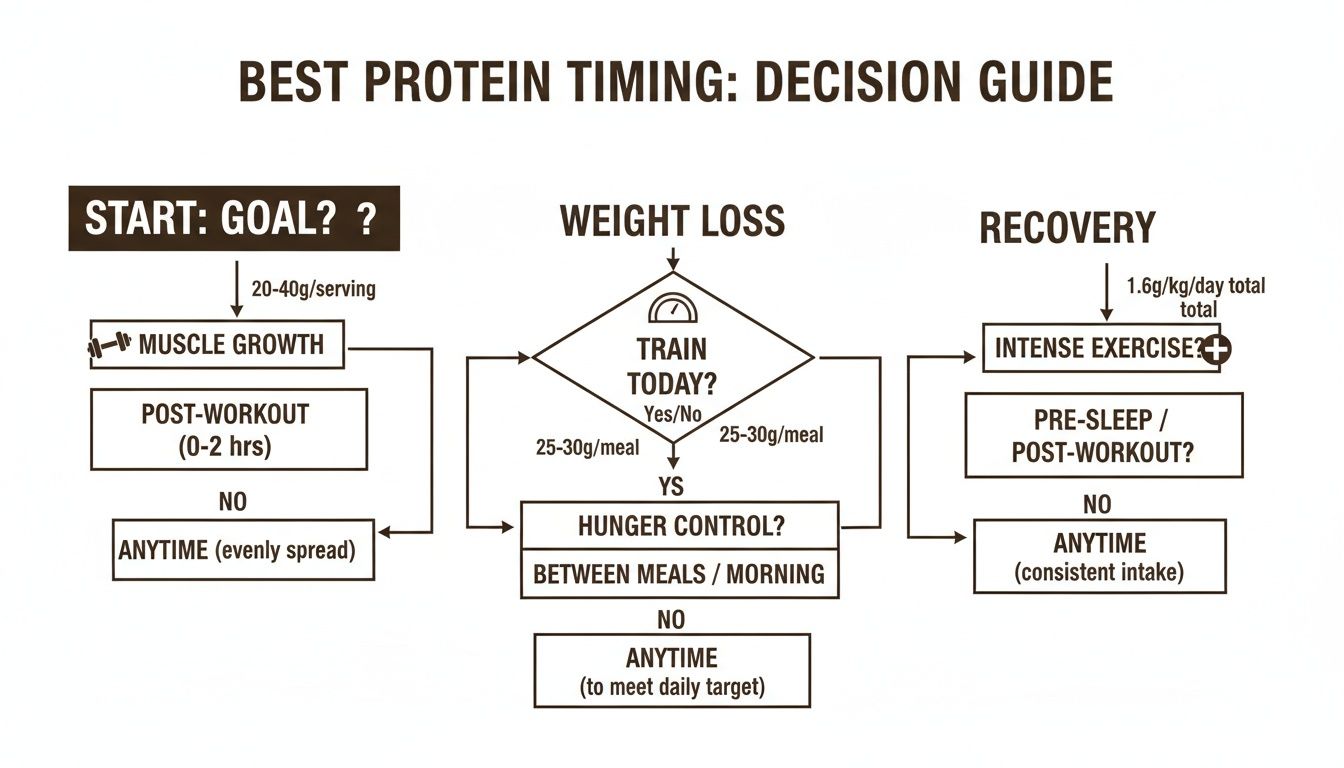
As you can see, your goal is the starting point. From there, you can trace the path to a protein schedule that actually supports what you're working towards.
Matching Your Goal to Your Shake
Let's break down how these different timings actually work. Once you understand the "why" behind each one, you can stop relying on generic advice and start building a plan that fits your life.
For example, if your primary focus is building muscle mass, you'll want to prioritize that post-workout window to give your muscles the raw materials they need to start repairing and growing right away. But if you're trying to shed some body fat, a morning shake might be your best bet to help manage hunger and keep cravings at bay all day long.
To make things even simpler, here's a quick reference guide that ties it all together.
Protein Timing Quick Reference Guide
This table matches different protein intake times with their main benefits and the ideal type of protein to use, helping you sync your supplement schedule with your fitness goals.
| Time to Take Protein | Primary Goal | Key Benefit | Recommended Protein Type |
|---|---|---|---|
| Post-Workout | Muscle Growth & Repair | Rapidly kicks off muscle repair and replenishes energy stores. | Fast-acting (Whey) |
| First Thing in the Morning | Weight Management & Satiety | Helps curb appetite, reduce cravings, and gets your metabolism going. | Fast-acting (Whey or Plant-based) |
| Before Bed | Overnight Recovery | Delivers a slow, steady stream of amino acids to prevent muscle breakdown while you sleep. | Slow-digesting (Casein) |
| Between Meals | Meeting Daily Protein Goals | A convenient way to hit your daily protein target and stay full. | Any (Whey, Casein, Plant-based) |
While nailing the timing can definitely give you an edge, remember the golden rule: hitting your total daily protein intake is what matters most. Think of these timing strategies as powerful ways to fine-tune your results, but they all have to be built on that solid foundation of getting enough protein, day in and day out.
The Post-Workout Anabolic Window: Myth vs. Reality

We've all heard the locker-room wisdom: you have exactly 30 minutes after your workout to chug a protein shake, or you might as well have stayed home. This is the infamous "anabolic window," a supposedly fleeting moment where your muscles are primed for maximum growth. But is this high-stakes countdown a physiological fact or just gym-floor fiction?
The logic behind the anabolic window is actually pretty solid. A hard workout leaves your muscles hungry for nutrients to kickstart the repair process. Introducing protein triggers muscle protein synthesis (MPS)—the biological mechanism that rebuilds and strengthens muscle fibers.
Think of your muscles like a construction site. The workout is the demolition crew, breaking things down. Protein is the shipment of raw materials—the bricks and mortar—needed to build back bigger and stronger. Without that delivery, the project stalls.
The Real Advantage of a Post-Workout Shake
So, while that frantic 30-minute deadline is mostly a myth, the benefits of refueling after your workout are absolutely real. The science is crystal clear: giving your body protein after training seriously improves recovery and your long-term results.
Getting those amino acids into your system helps replenish depleted energy and can take the edge off muscle soreness. In the long run, this means you can get back to training sooner and with more intensity.
Here's the bottom line: The anabolic window is much wider than we used to believe. But the core principle—fueling your body after you train—is still a cornerstone of smart muscle growth. Consistency is what pays off.
For someone hitting the weights consistently, the best time to take protein powder is still right after a session. It’s not just about convenience; it’s about results. Research repeatedly shows that 20-40 grams of protein post-workout measurably boosts muscle repair, reduces soreness, and leads to faster strength gains over time. You can dig deeper into the protein market and its fitness applications to see just how central this timing has become.
Separating Fact from Bro-Science
The myth isn't that post-workout protein is important—it is. The myth is the idea of a ridiculously narrow, all-or-nothing window. Modern research has shown that this "window" is far more forgiving, likely lasting a few hours, not minutes.
How urgent is it? That really depends on when you last ate.
- Trained Fasted? If you hit the gym on an empty stomach, then yes, getting a protein shake in your system within an hour or so is a very good idea.
- Ate a Pre-Workout Meal? If you had a protein-rich meal a couple of hours before training, those amino acids are still circulating. You have a lot more flexibility.
Ultimately, it all comes back to consistency. Making it a habit to have a protein shake or a high-protein meal within a couple of hours of your workout is a powerful, evidence-backed strategy. It guarantees your muscles get what they need to recover, adapt, and grow, turning all that hard work into real, lasting results.
Starting Your Day Strong with Morning Protein

What’s the first thing you reach for after waking up? For most of us, it’s coffee. But consider this: adding a scoop of protein to your morning routine could be a game-changer for building muscle and managing your weight.
Think about it. After sleeping for eight hours, your body has been fasting. It's looking for energy, and if it doesn't get it from food, it might start breaking down muscle tissue. This is known as a catabolic state. A morning protein shake is like putting high-octane fuel in an empty tank—it immediately halts that muscle breakdown and fires up your metabolism for the day.
The benefits don’t stop there, though. Protein in the morning is a fantastic way to keep your appetite in check. It helps you feel fuller for longer, which is a massive help if you're keeping an eye on your calories. It's like having a solid meal before a long road trip; you’re fueled up and far less likely to grab something unhealthy at the first rest stop.
Winning the Day with Breakfast Protein
The science backs this up. For anyone serious about their fitness, the morning is a prime opportunity to use protein powder to kickstart your metabolism and fend off cravings. In fact, research shows that a breakfast with 30 grams of protein can dramatically boost satiety hormones. This simple switch can lead to eating up to 400 fewer calories throughout the day compared to a carb-heavy breakfast.
Getting this right first thing sets a positive tone for the rest of your day, making it much easier to stick to your nutrition plan.
A morning protein shake does more than just feed your muscles; it sets your metabolic and hormonal stage for the next 12 hours, giving you a distinct advantage in managing hunger and energy levels.
Practical Tips for Your Morning Shake
You don’t need to overcomplicate things to get your protein in. Here are a few easy ways to make it happen:
- Keep It Simple: On those hectic mornings, just mix a scoop of a fast-digesting protein like whey isolate with water or milk. It’s ready in under a minute. Learn more in our guide on what whey protein isolate is.
- Boost Your Coffee: Ever tried a "proffee"? Just add a scoop of unflavored or vanilla protein powder to your coffee. You get a caffeine kick for alertness and protein for muscle repair all in one.
- Create a Smoothie: For a more complete meal, blend your protein powder with fruit, a handful of greens, and a healthy fat like almond butter. This makes for a nutrient-packed breakfast that will easily keep you full until lunchtime.
This one small tweak to your morning can have a huge impact on your body composition, energy levels, and appetite control, making it one of the absolute best times to take your protein powder.
Unlocking Overnight Recovery with Pre-Sleep Protein

We talk a lot about post-workout and morning shakes, but one of the most powerful strategies is often overlooked: taking protein right before you hit the sack.
Your body does its most critical repair work while you're asleep. It's when growth hormone levels surge, and muscle rebuilding kicks into high gear. By giving your body the right fuel before bed, you can take full advantage of this natural recovery window. The trick is to use a protein that digests slowly, feeding your muscles all night long.
The Power of Slow-Release Protein
Think of a fast-acting protein like whey as a quick jolt of fuel, perfect for right after a workout. But a slow-digesting protein like casein is a different beast entirely. It’s more like a time-release nutrient drip, steadily delivering amino acids to your muscles for hours on end.
This slow, continuous supply is exactly what you need overnight. It helps stop your body from slipping into a catabolic (muscle-breakdown) state during the long fast of sleep. Instead of cannibalizing your hard-earned muscle for energy, your body has a ready-to-use protein source for repair and growth.
For anyone serious about their training, this simple habit can be a game-changer for strength and size. You'll wake up feeling more recovered and ready to hit your next session at full throttle.
Maximizing Gains While You Sleep
This isn't just theory; the science backs it up. For night owls and anyone laser-focused on recovery, bedtime might just be the best time to take protein powder. It feeds the muscle repair process at the exact moment your body is primed for it.
In fact, some landmark studies have shown that consuming 40 grams of casein protein before sleep can boost overnight muscle protein synthesis by a whopping 22%.
Those numbers translate into real-world results. Participants in a 12-week study saw 30% greater gains in strength and size compared to a placebo group. It's no wonder that recent surveys show 35% of gym-goers are now prioritizing evening protein, linking it to a 15-20% reduced risk of injury.
Consuming a slow-digesting protein before bed is like hiring a construction crew to work the night shift on your muscles. It ensures the rebuilding process never stops, even while you're resting.
This strategy is especially effective if you’re trying to build lean mass or just recover faster between brutal workouts. If you want to dive deeper into recovery, check out our guide on the best protein powder for recovery. Making a pre-sleep shake part of your nightly routine is a smart way to capitalize on your body's natural processes, turning your sleep into a truly productive, muscle-building state.
Why Your Total Daily Protein Intake Matters Most
We’ve talked a lot about the strategic perks of timing your protein—after a workout, first thing in the morning, or before bed. But there's a much bigger rule that really drives your results: hitting your total daily protein target.
Think of it this way. Perfect timing is like arranging the furniture in a room for the best possible flow. It definitely makes a difference. But your total daily protein intake? That’s the house itself—the foundation, walls, and roof. Without that solid structure, it doesn't matter how well you arrange the furniture.
This is the bedrock principle for any effective nutrition plan, whether you're trying to build muscle, lose fat, or just recover faster. The best time to take protein powder always comes second to making sure your body has enough raw materials to work with all day long.
Shifting Focus From When to How Much
It's easy to get caught up in the details. But obsessing over a tiny 30-minute "anabolic window" while consistently falling short on your daily protein is a classic case of missing the forest for the trees.
Your muscles don't just clock in for repairs in the hour after you leave the gym. Recovery and growth is a continuous, 24/7 process.
The single most critical factor for your fitness goals isn't the exact minute you drink your shake. It's the total amount of protein your body gets over a full 24-hour period. Consistency beats timing, every single time.
So, how much do you need? A good rule of thumb for active people is 1.2 to 1.8 grams of protein per kilogram of body weight. For a 180-pound person (that’s about 82 kg), this works out to a daily goal of roughly 98 to 148 grams.
Hitting that number ensures your body has a steady supply of the amino acids it needs for that constant repair work. A protein shake is just a super convenient tool to help you close the gap between the protein you get from whole foods and the total your body demands. And if you're looking for more ways to build a powerful supplement routine, check out our guide on the best supplements for muscle growth.
Common Questions About Protein Powder Timing
Even with all the science laid out, you're probably wondering how this all fits into your actual, day-to-day life. Let's tackle some of the most common questions and turn the complex science into simple, practical habits.
Does It Matter If I Wait an Hour After My Workout?
The old-school idea of a super-short "anabolic window"—a frantic 30-minute race to down a shake—has been largely debunked. Modern research shows us this window is much more flexible, probably lasting for several hours after you train. The most important thing is simply getting quality protein in after your workout.
A good rule of thumb is to aim for your shake within two hours of finishing your session. That's a solid target for maximizing recovery. The only exception? If you trained completely fasted (say, first thing in the morning on an empty stomach), then getting that shake in sooner rather than later is a smart move to kickstart the repair process.
Should I Take Protein Powder on Rest Days?
Yes. Absolutely. Think about it: your muscles don't just grow and repair in the hour after you leave the gym. That process is an ongoing project that can take a full 24-48 hours.
Your muscles are still hard at work rebuilding on your days off. Keeping your protein intake high on rest days ensures they have a constant supply of the amino acids needed to fully recover and come back stronger for your next workout.
Can I Mix Protein Powder with Milk Instead of Water?
You definitely can, and it just depends on your goal. Using milk is a great strategy if you're trying to build muscle or gain weight, as it adds extra protein (especially slow-digesting casein) and calories. The trade-off is that it slows down the absorption rate.
If your main goal is rapid absorption right after a tough workout, or if you're keeping a close eye on your calories for weight loss, water is your best bet. It all comes down to what you need at that moment.
How Many Protein Shakes Should I Have Per Day?
There's no magic number here. Remember, protein shakes are supplements—they're meant to fill the gaps in a solid, whole-food diet, not replace it.
For most people, 1-2 shakes per day is the sweet spot. It's more than enough to help you hit your daily protein numbers without over-relying on them. Use them for convenience when you need it most, like after a workout or as a quick breakfast on a busy morning. But always prioritize getting high-quality protein from food sources like chicken, fish, eggs, and legumes first.
Ready to optimize your nutrition and recovery? T2LF SUPPLEMENTS offers elite, clean protein formulas designed to help you train harder, recover faster, and achieve real results. Discover the right protein for your goals at T2LF SUPPLEMENTS.
